
It's an exceptional year for an impressive insect. More...
The Humming-bird Hawk-moth, Macroglossum stellatarum, is traditionally an immigrant species whose numbers fluctuate from year to year, depending on the numbers that make it from their breeding grounds in Southern Europe. As our climate changes, more and more are breeding here, but how much do you know about this incredible insect?
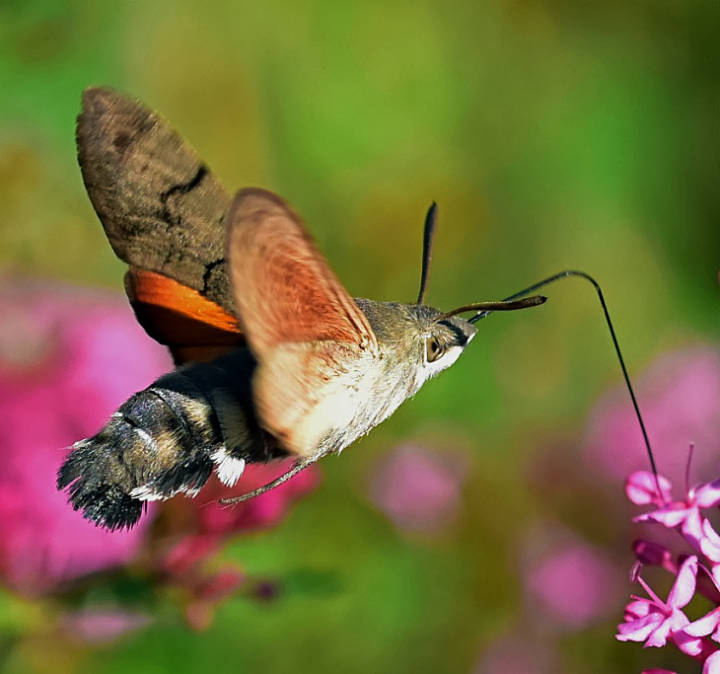
In flight, this moth flaps its wings around 70 to 80 times per second, fast enough to produce an audible humming sound and allow precise, stationary hovering. The tuft of broad, brush-like scales at the end of its abdomen functions like bird tail feathers, providing pitch stability while manoeuvring. Its straw-like tongue (proboscis) is roughly as long as its entire body, uncurling from a tight spiral to sip nectar deep within flowers while remaining airborne. Unlike the majority of moth species that fly at night, this moth flies almost exclusively in bright daylight and warm sunshine. For this reason it has advanced trichromatic colour vision and can distinguish subtle colour differences between flowers. Highly efficient at foraging, a single moth can visit up to 30 to 40 flowers per minute to meet the massive energy demands of hovering. This is a heat-loving insect, but to take off in cooler temperatures, it rapidly vibrates its flight muscles in place to warm up its thorax to around 30°C before flying.
Have you seen one of these incredible beasts yet?