
All images on this website have been taken in Leicestershire and Rutland by NatureSpot members. We welcome new contributions - just register and use the Submit Records form to post your photos. Click on any image below to visit the species page. The RED / AMBER / GREEN dots indicate how easy it is to identify the species - see our Identification Difficulty page for more information. A coloured rating followed by an exclamation mark denotes that different ID difficulties apply to either males and females or to the larvae - see the species page for more detail.
Bees, Wasps, Ants
Parasitoid and chalcid wasps - Chalcidoidea
Chalcid wasps (from the Latin, "chalcis" - metallic-coloured) are a very complex and species-rich group with constantly evolving taxonomy. In the UK, 1,754 recorded species were on the 2016 checklist, although this is certainly an underestimate of the total. All are endoparasitoids, the females laying eggs inside host eggs or larvae, which their larvae consume and kill. These tiny wasps often have a wide global distribution and in addition have been very widely used as biological pest control.
Aphelinidae
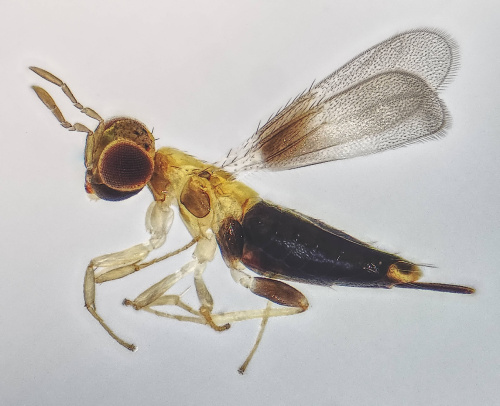
The Aphelinidae are some of the smaller chalcid wasps. Most aphelinids are less than 1.5 mm in length and brown or yellow in color. They are characterised by the antenna having four or less funicular segments, the tarsi with 4–5 segments, the fore tibial spur large, curved and bifid, the metasoma broadly joined to the thorax (not petiolate), and the notauli complete, straight, deep, and widely separated posteriorly (generally by more than the length of the scutellum). Most species are Most are primary parasitoids of Sternorrhyncha. Others attack eggs of these groups or of Orthoptera (grasshoppers and crickets). Many of the 1,300+ species in the family parasitize agriculturally important insects including whiteflies, scale insects, mealybugs and aphids.